Pages/ duilleagan

Showing posts with label Euskadi. Show all posts

Friday, October 24, 2014

Banned from the Mòd


Well, not banned. But Na Seudan Ura were given a stern dressing down for daring to put a dreaded 'modern' slant on their Gaelic folk music. Apparently one of the 'judges' for the 'Royal' National Mod managed to remove his or her head from their nether region just long enough to look down their nose at the group of teenagers and chastise them for their 'lounge jazz'.

It does nothing to dispel views of Scottish/ Gaelic speakers as old-fashioned and dour Presbyterians of the 'no sex as it might lead to dancing' mould.

It also does little to present Gaelic as a living modern tongue.

An Comann Gaidhealach, who have organised the National Mod for more than a century, have presided over the death of the language over much of the Scottish mainland. In 1892 when the first Mod was held, Gaelic was still spoken by local families and communities in places such as Caithness, East Sutherland, Easter Ross, Inverness-shire, Strathspey, Perthshire, Stirlingshire, Arran, the Angus glens and on Lomondside. Despite the pomp and pageantry and despite the Royal patronage, An Comann Gaidhealach did little or nothing to make a stand for Gaelic and to protect it in those communities. Comparisons with similar societies in other small nations are like chalk and cheese.

Cultural and political can be merged but not if you're too feart to offend the Royals and the lairds. Not if you're still doffing your cap and mustering a few words of gratitude to those, and their kind, who happily saw our glens emptied of people with the remaining men used as cannonfodder and any remnant 'native-speaking' children punished for that crime.

Sadly, in Scottish Gaelic culture, the world-views and words of long-dead poets and a vanished society hold more value than a vibrant and forward looking future.

Meanwhile, in the Basque Country, the local punks have a new CD out. The good news for An Comann Gaidhealach is that it isn't lounge-jazz. The bad news is....


Wednesday, July 17, 2013

San Fermin - Acts of Man


All cultures have their detritus. Some of it left over from less civilised times is filed alongside art, poetry and song under the catch-all term 'tradition'. In Scotland, we managed to get rid of fox-hunting but still allow our moorlands and hills to be ravaged so a few rich folk can come here and shoot some tame birds. We even have a golf club that - bizarrely in the year 2013 - doesn't admit women. Worse still, a course like Muirfield is still selected for a major championship.

Another sick 'tradition' that deserves to be binned is the San Fermin bull run. In the traditional Basque city of Pamplona or Iruñea in the indigenous tongue thousands of locals, Spaniards, Australians, Americans and Brits gather to slaughter and get slaughtered.

That's entertainment.

It's not just the bulls that are treated like lumps of flesh.


The tide seems to be turning against this barbarity though, both in Spain and in the Basque Country.

The 'Antitaurinos'


Protests are imaginative, graphic and multilingual.

Donostia/ San Sebastian

And the music which captures the moronism that surfaces here and in most cultures? The words come from the pen and genius of Scott Hutchison and Frightened Rabbit. Acts of Man:


Acts of Man by Frightened Rabbit on Grooveshark


I am that dickhead in the kitchen
Giving wine to your best girl's glass
I am the amateur pornographer
Unpleasant publisher by hand

Not here, not here, heroic acts of man

I see the stumbling pinstriped trouser
Flecks of sick on an office shoe
Part of the fatty British average
Who lives in the houses around you

Not here, not here, heroic acts of man

Let's all crowd 'round the cowering body
Throw stocky fingers, bricks and stones
Let's promise every girl we marry
We'll always love them when we probably won't

While the knight in shitty armour
Rips the drunk out of her dress
One man tears into another
Hides a coward's heart in a lion's chest

Man, he breeds although he shouldn't
He's breeding just because he comes
Acts the father for a minute
Till the worst instincts return

Not here, not here, heroic acts of man

I have never wanted more, to be your man
And build a house around you
I am just like all the rest of them
Sorry, selfish, trying to improve

Wednesday, July 3, 2013

Lipmugi Etxarri. Art of Crass.

From the Basque Country, a famous tune is plagiarised and young and old celebrate their Basque culture, old and new. Members of Hesian and other Euskal artists included. No cringing here!


From MocaTV, an insight into the art of Crass. It's maybe worth mentioning that Gee Vaucher's role in the collective and considerable contributions to Crass' output isn't covered in sufficient depth. Go here for more. Now you know where Banksy got his ideas.


And back home in Dùn Eideann:


Thursday, April 25, 2013

Gaelic space punks v. Tradfest


What was once the Edinburgh Folk Festival has now become 'Tradfest' after a brief stint as 'Ceilidh Culture'. There's probably a fair bit of it that is worth seeing - Gaelic songs and poems from Perthshire don't often get an airing for example. However, far too much of 'trad' music seems to involve... people sitting down to 'enjoy' the often furious dance music of the past and/ or a misty eyed regurgitation of a long-gone culture. The point being that's it's ok to remember the past and learn about our 'tradtional' music as long as the current generation is creating something of its own for the future.

Sometimes, 'Celtic' fests can accommodate alternative music such as Les Ramoneurs who regularly play the Lorient festival in Brittany. There is a a feeling that in Alba such music is looked down upon by those for whom traditional is a profession.

This is probably why we won't see the likes of Basque-language punk-ska band, Hesian, in Dùn Eideann at Tradfest....


Though our nearest equivalent, Oi Polloi, is playing 3 gigs in 24 hours. Most importantly, two of these are in conjunction with the launch of a Gaelic sci-fi novel by Tim Armstrong. Tim once played in trad ground breaking indie-rock band Na Gathan, dabbled in some Gaelic electro-pop and fronted the superb Mill a h-Uile Rud who took their Seattle-based Gaelic punk around Europe with Oi Polloi with a BBC Alba film crew in tow.

One of the gigs is in a Leith Walk record shop and the other is on a boat. Dìreach far out a dhuine... Get your tòn along to one or both of them.


Monday, November 26, 2012

Bollocks to the Stones - the alternatives...


Tired of the meeja coverage of Mick Jagger shaking his wrinkles with his fellow lovers of under-age lovers? As someone who was old enough to know what it was all about at the time, I still wonder why Bill Wyman didn't get the Gary Glitter treatment after he managed to get a lumber with Mandy Smith at the tender age of 14.

Hesian, London 2012

Never mind, I just wish I'd be able to have been present at the Basque Solidarity Sound System gig in Brixton last weekend. Raising money for and awareness of the blight of Basque prisoners in Spain, London and Edinburgh was the aim of the event. I can only hope that the likes of Hesian, Itziarren Semeak and Siroka make it up Scotland sometime soon.

Union Jack? Thall is Cac.
In the meantime, the once legendary - in some circles anyway - Antisect take the stage at Edinburgh Bannermans this Saturday. These noisy and political anarcho-punks from way back apparently influenced the likes of Neurosis and Godflesh. Expect some unremitting heavy music and harsh harsh vocals that will make Tom Waits sound like Jagger. Support comes from Dùn Eideann's premier purveyor's of Gaelic punk-rock, Oi Polloi.


On the downside, we hear that Liet International has convened a mysterious 'committee' that has 'chosen' a predictably dismal and not so 'ùr-nosach' piece of music to represent Alba in the minority language version of Eurovision. In the past, the great unwashed got the chance to vote for the likes of Welsh ska-indie music or Gaelic indie music to compete with Basque language rock music or Latvian death metal. This time, the plebes didn't get a vote and Gaelic Scotland is taking one step forward and two back in terms of 'new' music. Hey-ho, let's not go...

Sunday, September 23, 2012

Basque solidarity gig


Was a pleasure to meet some Basques on the independence march in Edinburgh. Some of their notable punk, rock, ska and hardcore bands will be over in Engerland's capital city in November to raise money for Basque prisoners in Spain. A worthy cause as Madrid's draconian way of dealing with 'the Basque Problem' is to lock up swathes of ordinary Basques - almost all of whom have no connections to violence.

Well worth supporting if you make it down. Otherwise, it would be a pleasure to see them in Scotland at some point - perhaps sharing a stage with our own indigenous rockers?

Monday, July 9, 2012

Basque punk rock


Have you ever heard of the Basque cringe? No. Doesn't exist. As mentioned earlier, on a recent trip to Euskadi I was struck by the self-confidence that the Basques seem to exude in whatever way they choose to express themselves.

Though it may not seem like it, the Basque language - Euskera - is still a minority tongue within the boundaries of their nation. However, concerted efforts by everyone from youth groups to teachers to politicians and punks have seen the oldest language in Europe take the momentum. Like Faroese or Hebrew that went from moribund to first state language, I have no doubt that it will become the first tongue of most Basques in the very near future.

I also note that many of the young bands incorporate aspects of traditional culture into what they do. It could be elements of tradtional Basque dress, instruments or iconography but it's there as a badge of pride and identity. Too many Scots see these icons as 'kitsch' and cringe from them or think they're best reserved for weddings or Hogmonay.

One reflection of the independent attitude was the channel Hamaika - one of at least three Basque language channels. It seemed to broadcast a daily gallery of music videos showcasing the breadth of Euskal musika. It was much to my taste with a lot of punk rock on show. Attitude and political awareness was there in spadefuls. Here's a taste...

Siroka are a current hit in the Tocasaid bothie of sound. This song which features a number of other Basque musicians deals with the shameful treatment of Basque political prisoners - from anarchists and pacifists to suspected ETA members - by the Spanish and French authorities.


Xarma are in a similar vein. This time with their female member doing vocal duties on a song against the persistent problem of violence against women.


Negu Gorriak are perhaps best known outside Euskadi. I picked up one of their CDs a few years ago on which they covered international punk, rock and hip-hop songs in their own language. Their Basque version of Minor Threat's 'Small man, big mouth' was particularly memorable. This was a band with a hard political edge and the balls to match. They formed in the 80s and were active at a time when the post-Franco 'democracy' of Spain was continuing the Madrid-centred repression of Basque people, and not just hardline ETA members. Remember the assassination squads of the 'Socialist' Madrid government? This quote from Wiki illustrates matters:
They were completely committed to the political movement, starting with their choice to sing only in Euskera and continuing through their way of work and the message in their songs. They decided to manage themselves and created the record label Esan Ozenki. They performed their first concert in front of Herrera de la Mancha maximum security prison, leading to problems with the government. They were renounced by the Guardia Civil general, Enrique Rodríguez Galindo for the lyrics of the song «Ustelkeria», which accuses the general and the Guardia Civil of being involved in drug trafficking. This was the first time since the end of Franco's regime that the government denounced a form of expression. These charges were dropped in 2001, five years after the group stopped performing together. In honour of their legal victory, the group performed three celebratory concerts to more than 30,000 people.
Here's another article on Negu Gorriak by a Canadian author. I like the reference to 'decolonization movements'.  Here they are taunting the Spanish authorities outside the Herrrera de la Mancha prison.


Onto more modern stuff but still with Euskera and politics at the heart of it, singalong punk in the vein of Rancid or Dropkick Murphys with heavy doses of ska is well represented - Itziarren Semeak:


Hesian are similar:


More fusion stuff and an interesting crossover of punk, metal and electro. Whatever, the medium is the message. Zein da Zein? are Primal Scream meeting Leatherface.


Lastly, when I was at school the Abrasive Wheels classic 'Burn the Schools' was popular with some of us. Here though is a pro-school singalong from Banda Batxoki. The schools though are the successful and multicultural Basque language Eskola.


Here's hoping someone can get Na Gathan or Oi Polloi in to entertain and inspire our kids in our own Gaelic medium schools. Gaelic punk rock could be the soundtrack of our independence...


Thursday, July 5, 2012

Euskadi - colour and culture against the big nations


Having been in the Basque Country for the past few days, I've noticed much in comparison with the situation at home in Scotland from both the Spanish and French 'occupied' territories. As my visit has coincided with the final stages of Euro 2012 and the progress of Spain, the rather lacklustre support for the Spanish 'national' team has been palpable. Walking the streets of Bilbo and Donostia, you could be forgiven for forgetting that the tournament was even taking place.

In Bilbo, flags and banners celebrating the rise in fortunes of the local AC Bilbao - defacto Basque national team - are still everywhere, in shops, in cars and hanging from balconies. While there was cheering from local tabernas upon the Spanish victory, the flags and shirts of Spain have remained nowhere to be seen.

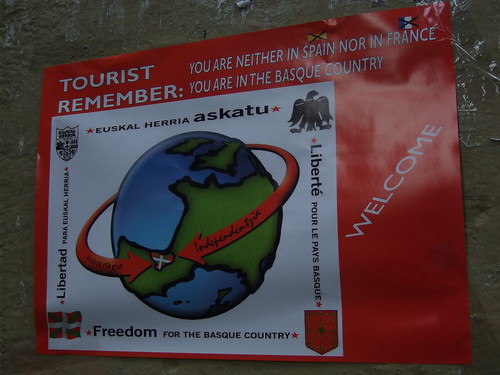
Posters on the walls remind you that 'this isn't Spain, this is Euskal Herria'. Though to be honest the indigenous culture screams at you. In Basque.

Language is and isn't a political issue. In Scotland, it just isn't. Scottish is far too often ignored by Scots and a glaring example of this is the 'Yes' campaign for independence. I'm not arguing for Scottish Gaelic to be 'promoted' by the Yes campaign. I'm arguing that it should be used. Scottish has shared a certain parity with English in as much as it's supported from different parts of the political spectrum. A language is a medium and the Yes campaign needs to harness any and every medium available particularly a language that is the anchor of the nation's culture and iconography.

The Basques on the other hand live their language across all domains within the Basque Autonomous Community - it's not just an adornment or prop for the tourists. The BAC apparently enjoys more power than any other non-nation-state on earth. It has huge industrial value and is wealthy by anyone's reckoning. It's easy to see why the monster of the Spanish state doesn't want to let it go.

In Scotland, I've noticed a new and predictable stooshie over the Scottish Government's plans to signpost all major routes in both English and Scottish. This wouldn't happen in Euskadi though it would seem as if the Basques are bold in most things they do once they are freed from the chains of Spain or France.

Even the new architecture is bold, individual and very much a statement of confidence. The Guggenheim in Bilbo is just one example. Basque nationalists in power at 'devolved' and local level pulled out all the stops to ensure that the city's revitalisation started here. Under centralist rule from Madrid, Bilbo would probably have remained a rusting industrial backwater in a 'region' of Spain. It's not only the Guggenheim though. Another example is the office of the health department in Bilbo newtown with its angular, idiosyncratic and mirrored facade. A behemoth of an old wine warehouse has been turned into a state of the art centre for culture and recreation which incorporates galleries, cinema and a glass bottomed swimming pool. Bilbo even has relatively new tram and metro systems - themselves works of art. Sure, all this costs money but what doesn't?

Which brings me back to language.

Most detractors of Scottish in Scotland are monoglots to whom bilingualism is a mystery. Occasionally though, some will embrace the benefits of bilingualism but insist that additional languages be 'useful' so that the outlay can be seen to be 'prudent'. Linguists  however declare that there is no such thing as a 'useless' language though tinpot bigots argue that only big boys of English, Spanish or Chinese - the Walmarts, IKEAs and McDonalds - of the language world are worth acquiring.

This leads me to ask, 'why Dutch?'. Almost everyone in the Netherlands speaks excellent English. Why then do the Dutch insist on speaking... Dutch?

The Basques, despite being 'fiercly nationalistic' as some might put it, also embrace multi-lingualism and multi-culturalism. I would contend that the territory under Basque control is one of most colourful, welcoming and outward looking areas in Europe. The European Union's advice on language in education is that each member state should teach 'mother tongue plus two'. The Basques insist on 'two mother tongues' plus two.

Hence some 80% of Basque primary children in the majority Basque-medium system are immersed in three languages from age zero and enter secondary school with complete or near fluency in three languages. Once in secondary, they acquire a fourth tongue which could be French, Arabic, Polish or German. Local demographics such as a significant number of immigrants often dictates the lingo learned. It's difficult to imagine white English kids in Bradford learning Urdu or Arabic or native Scottish bairns in Leith picking up Polish or Spanish.

However, the 'big nation' philosophy becomes more apparent once you cross the bridge from Irun into French Basque Hendaia. Here, some progress has been made in displaying the Basque tongue on some public roadsigns though it's obvious that the wrathful and jealous French god in Paris sees too much indulgence in languages other than French as sinful. Here, the use of Basque sadly reminds one of Scottish in Scotland - it is used sparingly but comes across as a 'prop' to paraphrase the linguist Joshua Fishman.

The shortcomings of the insular big nation with its siege mentality are also evident at the local SCNF station where the young lass on the ticket desk was unable to communicate in any other language than French. This despite the Spanish Basque country being only yards from her seat. Our pooled family tongues of Engerlish, Spanish and German fell on stony ground. Even an appeal to the auld alliance by using pigeon French-Gaelic failed.

Back in our Donostia-San Sebastian base, we watch one of the Basque language telly channels - Hamaika - which has an afternoon slot showcasing the varied Basque language music scene. It was pleasing to note many bands of the tuneful punk variety though metal, rock, pop and world music/ ska fusion was also present. Sadly, a similar program on BBC Alba which didn't feature fiddlers, songs written by dead poets, Gaelic choirs or religious music would be ten minutes long. Basque language punk is for another blog though.

The Basque Country, or most of it, is but a bawhair from complete independence. Even without the full complement of powers, it a shining example of the need to vote 'Yes' to Scottish independence in 2014. We could vote 'no' and remain a region with no voice or independent contribution of our own to the world community. We would remain tied to an inward looking and fearful big nation that remains in thrall to banks and big business, however corrupt. Or maybe we could use independence as a springboard for an open, progressive and internationalist nation that embraces our own languages as well as the cultures of others?

An elderly woman on a bus engaged us in conversation. I spoke in mistake-riddled Spanish. She replied that 'we have two idiomas'. 'So do we' said I. 'I know' she continued, 'and we're both at the same place'.

I was a bit puzzled and thought something had gone missing in translation. 'What place?'

'Independence', she replied.

Gora Euskadi. Saor Alba.