Pages/ duilleagan

Showing posts with label Alba. Show all posts

Thursday, July 5, 2012

Euskadi - colour and culture against the big nations


Having been in the Basque Country for the past few days, I've noticed much in comparison with the situation at home in Scotland from both the Spanish and French 'occupied' territories. As my visit has coincided with the final stages of Euro 2012 and the progress of Spain, the rather lacklustre support for the Spanish 'national' team has been palpable. Walking the streets of Bilbo and Donostia, you could be forgiven for forgetting that the tournament was even taking place.
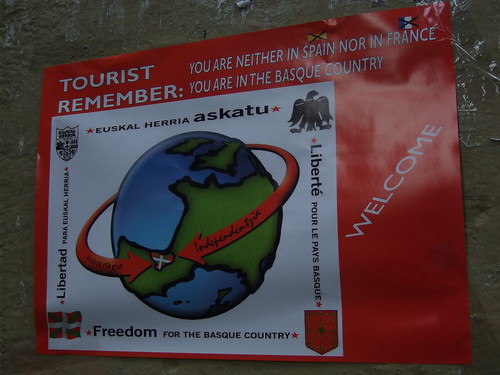
In Bilbo, flags and banners celebrating the rise in fortunes of the local AC Bilbao - defacto Basque national team - are still everywhere, in shops, in cars and hanging from balconies. While there was cheering from local tabernas upon the Spanish victory, the flags and shirts of Spain have remained nowhere to be seen.

Posters on the walls remind you that 'this isn't Spain, this is Euskal Herria'. Though to be honest the indigenous culture screams at you. In Basque.

Language is and isn't a political issue. In Scotland, it just isn't. Scottish is far too often ignored by Scots and a glaring example of this is the 'Yes' campaign for independence. I'm not arguing for Scottish Gaelic to be 'promoted' by the Yes campaign. I'm arguing that it should be used. Scottish has shared a certain parity with English in as much as it's supported from different parts of the political spectrum. A language is a medium and the Yes campaign needs to harness any and every medium available particularly a language that is the anchor of the nation's culture and iconography.

The Basques on the other hand live their language across all domains within the Basque Autonomous Community - it's not just an adornment or prop for the tourists. The BAC apparently enjoys more power than any other non-nation-state on earth. It has huge industrial value and is wealthy by anyone's reckoning. It's easy to see why the monster of the Spanish state doesn't want to let it go.

In Scotland, I've noticed a new and predictable stooshie over the Scottish Government's plans to signpost all major routes in both English and Scottish. This wouldn't happen in Euskadi though it would seem as if the Basques are bold in most things they do once they are freed from the chains of Spain or France.

Even the new architecture is bold, individual and very much a statement of confidence. The Guggenheim in Bilbo is just one example. Basque nationalists in power at 'devolved' and local level pulled out all the stops to ensure that the city's revitalisation started here. Under centralist rule from Madrid, Bilbo would probably have remained a rusting industrial backwater in a 'region' of Spain. It's not only the Guggenheim though. Another example is the office of the health department in Bilbo newtown with its angular, idiosyncratic and mirrored facade. A behemoth of an old wine warehouse has been turned into a state of the art centre for culture and recreation which incorporates galleries, cinema and a glass bottomed swimming pool. Bilbo even has relatively new tram and metro systems - themselves works of art. Sure, all this costs money but what doesn't?

Which brings me back to language.

Most detractors of Scottish in Scotland are monoglots to whom bilingualism is a mystery. Occasionally though, some will embrace the benefits of bilingualism but insist that additional languages be 'useful' so that the outlay can be seen to be 'prudent'. Linguists  however declare that there is no such thing as a 'useless' language though tinpot bigots argue that only big boys of English, Spanish or Chinese - the Walmarts, IKEAs and McDonalds - of the language world are worth acquiring.

This leads me to ask, 'why Dutch?'. Almost everyone in the Netherlands speaks excellent English. Why then do the Dutch insist on speaking... Dutch?

The Basques, despite being 'fiercly nationalistic' as some might put it, also embrace multi-lingualism and multi-culturalism. I would contend that the territory under Basque control is one of most colourful, welcoming and outward looking areas in Europe. The European Union's advice on language in education is that each member state should teach 'mother tongue plus two'. The Basques insist on 'two mother tongues' plus two.

Hence some 80% of Basque primary children in the majority Basque-medium system are immersed in three languages from age zero and enter secondary school with complete or near fluency in three languages. Once in secondary, they acquire a fourth tongue which could be French, Arabic, Polish or German. Local demographics such as a significant number of immigrants often dictates the lingo learned. It's difficult to imagine white English kids in Bradford learning Urdu or Arabic or native Scottish bairns in Leith picking up Polish or Spanish.

However, the 'big nation' philosophy becomes more apparent once you cross the bridge from Irun into French Basque Hendaia. Here, some progress has been made in displaying the Basque tongue on some public roadsigns though it's obvious that the wrathful and jealous French god in Paris sees too much indulgence in languages other than French as sinful. Here, the use of Basque sadly reminds one of Scottish in Scotland - it is used sparingly but comes across as a 'prop' to paraphrase the linguist Joshua Fishman.

The shortcomings of the insular big nation with its siege mentality are also evident at the local SCNF station where the young lass on the ticket desk was unable to communicate in any other language than French. This despite the Spanish Basque country being only yards from her seat. Our pooled family tongues of Engerlish, Spanish and German fell on stony ground. Even an appeal to the auld alliance by using pigeon French-Gaelic failed.

Back in our Donostia-San Sebastian base, we watch one of the Basque language telly channels - Hamaika - which has an afternoon slot showcasing the varied Basque language music scene. It was pleasing to note many bands of the tuneful punk variety though metal, rock, pop and world music/ ska fusion was also present. Sadly, a similar program on BBC Alba which didn't feature fiddlers, songs written by dead poets, Gaelic choirs or religious music would be ten minutes long. Basque language punk is for another blog though.

The Basque Country, or most of it, is but a bawhair from complete independence. Even without the full complement of powers, it a shining example of the need to vote 'Yes' to Scottish independence in 2014. We could vote 'no' and remain a region with no voice or independent contribution of our own to the world community. We would remain tied to an inward looking and fearful big nation that remains in thrall to banks and big business, however corrupt. Or maybe we could use independence as a springboard for an open, progressive and internationalist nation that embraces our own languages as well as the cultures of others?

An elderly woman on a bus engaged us in conversation. I spoke in mistake-riddled Spanish. She replied that 'we have two idiomas'. 'So do we' said I. 'I know' she continued, 'and we're both at the same place'.

I was a bit puzzled and thought something had gone missing in translation. 'What place?'

'Independence', she replied.

Gora Euskadi. Saor Alba.

Thursday, November 17, 2011

The Scottish Cenobite and Unionist Party versus botulism

Toxicity has taken hold in Scotland. Loyd Grossman has flooded Alba with jars of botulism sauce in a desperate attempt to overtake the Tories in the popularity stakes. The Tories have revelled in their sickness for years like a collective Dennis Nilsen. However, the turkey jowled Murdo Fraser thought it time to kill of the toxicity of the Tories by whisking them in an autoclave. Some thought it a clever ploy, to kill of the Tories by name and reinvent them as something even more sinister - Bavarian nationalists!  Fraser though just nicked his idea from the Wiki entry on botulism:
Conservatism can be prevented by killing the spores by pressure cooking or autoclaving at 121 °C (250 °F) for 3 minutes or providing conditions that prevent the spores from growing. The toxin itself is destroyed by normal cooking processes - that is, boiling for a few minutes.
Instead, a narrow majority of Tories kept hold of their spores and went radical. The appointment of Ruth Davidson is a bold step. Here is a senior Tory who is open about her sexuality, unlike half of the Tory cabinet in London. This is indeed momentous. This is the party who introduced the Section (Clause) 28 law which attempted to ban the 'teaching' of homosexuality in schools - an attempt to introduce it into Britain's zoos to stop homosexual behaviour amongst monkeys, penguins and even dragonflies narrowly failed. The Tories while having become more gay-friendly are still intent on shoving 'family values' down people's throats though. At a time of cuts, they are proposing tax-breaks for those who 'choose' to get married.

Whatever, it has to be said that it was refreshing to have a Tory leadership contest whereby the openly gay, or otherwise, candidates didn't suddenly get married to a hitherto unheard of 'long-term' partner of the opposite sex thus satisfying the cravings of the Daily Mail types who are the 'life' blood of the party.

Scottish Tories go all out for votes with new leader
What may be good for society is probably bad for Tories though and sure enough, the cracks are already showing. Within hours, Catholic conservative and self-proclaimed Celtic FC czar Paul McBride QC had resigned. The Pope's continued hostility to homosexuality was wisely not mentioned as a reason and instead, Paul the Victim merely stated that Davidson was 'not a very nice woman' and observed that 87% of the Scots electorate despise the party. Certainly, it hard to see this situation improving. With a party in disarray and a new leader who looks like the infamous Cenobite Chatterteeth from Hellraiser, their electoral fortunes are doomed to sink even further. Good riddance to them.

This would of course leave the way clear for Grossman's Botulism Party to fill that third position in Scottish politics and leave the less popular Tories/ Lib Dems fighting for the scraps at the bottom of the heap along with other anti-social irritants such as those who stick fireworks into kitten's tooshies.

Saturday, March 5, 2011

Aye can? My Erse.


Its census time and the onslaught against our indigenous culture continues. The auld myths about Scotland and her cultural roots are being trotted out by everyone from the  General Register Office of Scotland to Newsnet Scotland. It is often said that 'divide and rule' is the best strategy of the aggressor. And thus, we were divided. Scotland became, not the Celtic kingdom of Alba, but a nation divided between 'Highlands' and 'Lowlands'. This took time though and this distinction between Highland and Lowland only emerged relatively recently. Highland was 'Gaelic' and Lowland was... well, what was Lowland? The Anglo-Saxons brought 'Inglis' and Inglis it was until it suddenly became 'Scottish'. What then of Scottish? Scottish became Gaelic, Highland or even worse 'Erse'. More than divide and rule, the Scots found themselves identified by another nationality and thus dispossessed.

The Lowlands therefore became the sole preserve of Inglis/ Scots - even though at the time much of the Lowlands was still Gaelic speaking.  

Scotland then became 'Northern Britain' and eventually the powers that be, in a fit of irony, even decreed that Inglis was just 'badly spoken English'.

Historical extent of Gaelic expansion
This supreme piece of anti-Scottish spin-doctoring and cultural airbrushing provided the perfect springboard for centuries of repression starting with the Statutes of Iona, continuing with the Clearances and the education act of 1872 that permitted the forcible Anglicisation of Gaelic-speaking children and communities until the present day when one can still read derogatory comments about 'Erse' and 'garlic' in the comments sections of the Daily Mail and Scotsman. It can allow the likes of Marilyne Maclaren - Edinburgh's education chief (!!!) - in her attempt to hinder the establishment of a stand-alone Gaelic medium school in Edinburgh to claim that Gaelic's place is in 'Argyll or the west Highlands'.

The 'Aye Can' website - a product of the General Register and the ironically named 'Scots Language Centre' - which seeks to help people determine whether or not they speak 'Scots' states:
Are Gaelic and Scots different things?

Yes. Scots belongs to the Germanic family of languages (which includes Dutch, German, English and Swedish) and has traditionally been spoken in the southern and eastern parts of Scotland known as the Lowlands.

Gaelic, on the other hand, belongs to the Celtic family of languages (which includes Irish and Welsh) and has traditionally been spoken in the northern and western parts of Scotland known as the Highlands.
At best, this is a collection of half-truths. At worse, it is anti-Scottish. A good example of this can be found in the 'View from the Wasteland' blog which also states that the 'flag of our country is the Union Jack':
Yet ours is a rich language , spoken by plain men and men of learning for many centuries . John Barbour wrote in Scots for the Scots King when the English monarchy and aristocracy spoke French and English was regarded as a rural patois . Let it be remembered that , such was the strength of the Renaissance in this country , The Aeneid was translated into Scots before it was into English . This is no ill-spoken rustic dialect .

It would be tragic were it to disappear . Or , worse , be killed by the onslaught of meejah culture and aggressive Gaelic promotion .

I am a Scotsman . I speak Scots , not Erse .

The Census , due on the 27th of March , asks questions about our fluency in the guid Scots . It is incumbent on all who love our country and its heritage to answer truthfully and support oor mither tongue .
The idea that the Lowlands was devoid of Gaelic culture was certainly a new one to the last native Gaelic speakers of Arran in the 20th century:
"Some years ago I heard Gaelic speakers in Arran describe the
entire stretch of coastland from Galloway to Ayrshire as part of the
Gàidhealtachd. They knew some of the place-names of that region in
their Gaelic form; it was traditional knowledge among them that the
Gaelic language had been spoken there in the past; and they assumed
that, just as in Arran, it had survived to the present day."
To sum up, the Gaelic perception of the Lowlands is in
essential agreement with that of the medieval Scots writers who regard
the Gaels of their time as 'contemporary ancestors', people who
preserve the language and culture which were once shared by all. But
from the Gaelic point of view, we the Gaels are the disinherited, the
dispossessed. 
(John MacInnes, The Gaelic Perception of the Lowlands, "Gaelic and Scotland/Alba agus a' Ghàidhlig", ed. Wm Gillies, Edinburgh University Press, 1989)
Coronation of King Alexander III on Moot Hill, Scone on 13 July 1249. He is being greeted by the ollamh rìgh, the royal poet, who is addressing him with the proclamation "Benach De Re Albanne" (= Beannachd Dè Rìgh Alban, "God's Blessing on the King of Scotland"); the poet goes on to recite Alexander's genealogy.
This is not to paint Scotland/ Alba as a monolingual nation. I'm unsure if such a concept exists. Even the relatively linguistically 'pure' Iceland has a smattering of Gaelic placenames, handed down from Celtic monks who reached the islands before the Norse and latterly by Gaelic-speaking slaves brought there from their homelands of Scotland, Man and Ireland. Some seek to muddy the waters by highlighting Pictish and 'Welsh'. Though the minute someone speaks of 'Welsh' in a Scottish context, one should treat their arguments with the same amount of salt you'd give to a Daily Mail article. Brythonnic which was closely related to Gaelic was spoken here and is evidenced in poetry - Y Gododdin - and in placenames - Niddry for a starter. However, Watson in his 'Celtic Placenames of Scotland' states that 'there are more placenames of Gaelic origin around Peebles than those of Brythonnic origin'. The strange conclusion for some though is that 'Welsh' was spoken in the Lothians but not Gaelic. Were pre-Celtic Pictish, Brythonnic or Norn in the Northern Isles still to exist then their survival would be equally important. I get the feeling though that even in that situation, we'd hear the same complaints from the same people.
"It was during this period, probably from about AD 960 onwards,
that Gaelic came to be current in Lothian: there is some evidence that
it extended beyond the present boundary of Scotland." Page footnote:
"Gaelic place-names are found in the north of England."
("The Celtic Placenames of Scotland", WJ Watson, published by Birlinn)
So, what of Scots? There is no doubt that a northern branch of Anglo-Saxon did develop separately to that spoken in much of England and that it too has a place in our culture. Most of us still speak it to some extent, though I'd argue that for most us, it has become very much diluted and not only by 'standard' English but by recent inputs from Hispanic, African-American and American English. I'd argue that 'Scottish English' would be a more suitable and honest term for this tongue.

This is not acceptable to some though - including some nationalists who have now started to revise history by claiming that 'Scots' and not 'Inglis' was historically spoken in Alba. As mentioned, 'Scots' was a term that was pasted onto 'Scottice' in the 1600s and even today is not a universally recognised term by its speakers - Lallans, Doric, Scotch or the more regional Shetlandic are as often heard. Possibly because some see these Anglo dialects as being sufficiently different from each other to qualify as languages in their own right.

The cumulative effect of this romantic airbrushing, historical revisionism and aggressive anti-Celitc prejudice is that many Scots do feel that Gaelic is 'foreign' to them. Ask them to explain their local placenames and they're stumped. Ask them what the daily language of William Wallace and the Bruce was and you might get a shrug of the shoulders and the reply, 'English?'.  Ask them the source of the icons which give us our Scottish identity - even accounting for Victorian remixes by Walter Scott et al - such as bagpipes, whisky, tartan, the clans, the Stone of Destiny, ceilidhs, shinty (and arguably golf), the toponymy of lochs, bens and glens... and you'll get another shrug.
 
I once witnessed a folk singer in a Highland Perthshire pub being questioned by a German on the meaning of the line 'tha tighinn fodham' in the auld pro-Jacobite song 'Rise and Follow Charlie'. He looked puzzled for a few seconds and then replied, 'well, they're just kind of... Scottish sounds'.


The new Scotland? Forward with ignorance? Is it any wonder that tens of thousands of our youngsters tend to identify with an 'Old Firm' view of their lives in Scotland - Irish, Ulster Scots, British, English, Irish Catholic, proddie, 'Norn Iron' and Orange. Anything but Scottish.

Let us continue to speak our own form of Anglo-Saxon. Let us marvel at the words and use them in place of 'standard' English. Let us embrace the diversity of our new communities. But, we should be under no illusion that it was Gaels who gave us our nation, our iconography and much of our nomenclature. We should also ensure that it does not go the way of Pictish or Brythonnic.
"We look in vain for any hard and fast 'Highland Line' in the
minds or actions of these landowning families of the thirteenth, fourteenth and fifteenth centuries...
This essentially mixed situation, quite the reverse of black and white, characterised in the late medieval period and in the sixteenth and seventeenth centuries the gradual disappearance of the eastern Gàidhealtachd. The contribution of the 'western Gàidhealtachd' to the history and culture of Scotland may in some quarters have been sadly misunderstood and underrated, but it has never been in danger of being lost to sight. I would like to balance west with east by highlighting what I believe to have been the historically and culturally permanent contribution of Gaelic language and social organisation to the east of the country and the lowlands in general."
(GWS Barrow, The lost Gàidhealtachd of medieval Scotland, "Gaelic and Scotland/Alba agus a' Ghàidhlig", ed. Wm Gillies, Edinburgh University)

Update - Does Scotland and Gaelic needs enemies when its own people are this ignorant? Due to complaints, it seems as if 'Aye Can' has changed their tone... and made it worse. It now reads...

Gaelic, on the other hand, belongs to the Celtic family of languages (which includes Irish and Welsh). In recent centuries Gaelic has mostly been spoken in the northern and western parts of Scotland.

Have the Top Gear team taken control of history at the 'Scots Language Centre'? 'Recent centuries' would see Gaelic spoken in much of the Lowlands including Fife and Galloway...