Pages/ duilleagan

Showing posts with label bilingualism. Show all posts

Thursday, April 28, 2016

Scottish Gaelic in the #SP16 manifestos


Or not, in the case of RISE Scotland and the Lib Dems. But more about them later.

With the Scottish elections air faire - I thought I'd break my sabbatical to explore what the main parties have to say on the place of Scottish/ Gaelic in our society. Gaelic is mostly a non-partisan issue. It is a language and if it is truly of equal worth and status then a plurality of viewpoints expressed through it as a medium should not be a surprise. There are some bigots whose regular but erroneous outbursts on Gaelic issues are fodder for a new ugly breed of fringe Unionists but by and large Scottish is supported across the political spectrum.

Despite the gurning that the SNP are 'forcing' Gaelic onto an unwilling populace, they are for the most part only following legislation signed or implemented by Tories, Labour and Lib Dems in both Westminster and Hollywood.

Here we go. Let's get the worst done and over with...

The Tories - despite loose cannons like Alex Johnstone and Jackson Carlaw - the truth is that the Tories have supported Gaelic since Thatcher. Significant funding for Gaelic was first put in place by a Tory government in London. In their current manifesto, they even have a picture of Bagh a' Chaisteil and manage to state:
We continue to support Gaelic education and would welcome further dedicated Gaelic schools being set up.
Labour - the Branch Office has been generally supportive over the years. Alasdair Campbell is a piper of Gaelic-speaking Tirisdeach stock while the arch-Unionist and pro-nuke bag of bitterness that is Brian Wilson can even speak it to some degree and has been a vociferous proponent of the tongue for decades. On the other hand, one of Kezia Dugdale's first statements after expressing shock at being elected (you're not alone there a' ghràidh) was to oppose BBC Alba receiving a slot on Freeview.

Labour though is currently a chaotic mess on many fronts. As I write, a mere week before the election, their manifesto is hot of the presses. Well, kind of lukewarm. In fact, it seemed as if Scottish Labour would abstain on a manifesto this year. Sure enough given the ever decreasing standards of Labour personnel over the past few years this manifesto made even Rise Scotland's seem slick.

Two gaffes immediately caught the eye. First, the online version was published with at least one section missing - the now infamous 'hello there, hello here' gunshot to foot. Next in the language section was this...


Where on earth did they get 'Nordic' from? Norn or Norse? Or did they mean Doric? This sums up a party that has taken the electorate for granted for decades - producing shoddy campaign material with factual errors, spelling mistakes and all the finesse of a stoner staying up all night to finish a crucial essay before next day's deadline.

As to the real life language that is Gaelic, it's pretty wishy washy. Just what you'd expect from a party now famous for abstaining.

Shame, as it wasn't always like this. In their 2011 manifesto for the Highlands and Islands they stated:
Scottish Labour recognises the crucial importance of Gaelic medium education to the continued survival and flourishing of the language. We support an expansion of opportunities for learning Gaelic, including removing the obstacles to Gaelic education and growing the number of Gaelic medium teachers, especially in areas where there is strong parental demand. We will build on the achievements of the Gaelic Language Act and will enhance our support for Gaelic through encouraging Gaelic broadcasting, Gaelic arts and increased visibility for the Gaelic language in Scotland. We will also support the work of Sabhal Mòr Ostaig, the Gaelic college on Skye, and encourage new learners as well as native speakers from the traditional heartlands and beyond.


Liberal Democrats - skimming over this document after taking several wrong turns in their garish eye-stabbing website was worse than perusing the Tories' letter to Santa. Please note, multiple pics of Willie Rennie (minus mating swine) is not a positive! He either looks as if he's struggling with a bout of anal cramps or is trying very, very hard to add up the numbers of remaining Lib Dem MSPs.

This is a party that has lost any relevance it once had. With a strong representation in the Highlands, it was once very pro-Gaelic. Elected members such as John Farquhar Munro and Charlie Kennedy not only spoke Gaelic to varying degrees of fluency but were honest, likeable and even radical politicians. Now, we see the likes of the ridiculous Tavish Scott - son of the laird - playing the anti-Gaelic card in an attempt to hold onto the party's remaining 'heartland' of the Northern Isles where Gaelic does have a 'history' albeit not as a recently spoken community language by a significant percentage of the locals.

In 2011 though, they did say:
Support Gaelic medium education where there is demand and promote the language in cost effective ways.
Though funnily enough they now say that if parents in Shetland were to demand GME, they would oppose the desire of those Shetlanders to have their kids educated in Gaelic. Then again, what do you expect? They are Lib Dems after all. Would you trust a Lib Dem?

Curiously, the link to the Lib Dem manifesto I sourced included the words 'no to nuisance callers' (??!)

Answers in a Tweet please...

Scottish Greens - their online document is certainly more pleasing to the eye and does not focus on one personality (if that applies to Wille Rennie). Nothing on Gaelic education but this comes in under Arts and Cultural Diversity:
We support cultural ventures in all the languages of Scotland, including measures to encourage the use of Gaelic, the Scots tongue and the languages of those from minority ethnic backgrounds
Could do better. Support is good but any new ideas at developing the use of Gaelic?

SNP - Compared to some 'national movements' the SNP has been relatively 'language-lite' perhaps in an attempt not to 'scare the horses' as was said of the Yes campaign. Gone are the days when Gaelic slogans were part and parcel of SNP conferences. On the face of it, the SNP offer perhaps the strongest case for Gaelic though as mentioned above, until now they have mostly been building on common ground cultivated by the three main Unionist parties. That said, the present Gaelic 'heartland' of Na h-Eileanan Siar is strongly SNP at both Holyrood and Westminster levels.

Here though we have a bit more to chew on with Gaelic coming under both education and culture (A Creative Scotland) - not rocket science but something the other parties have failed to recognise. Here we go:

We will also implement new legal duties and rights to support Gaelic Medium Education as part of our ongoing commitment to stabilise and increase the number of Gaelic speakers.

 We support the central role of Gaelic arts in engaging people with the language, and enhancing the relevance of the language to Scottish society. We will also provide support for the Scots language

 We will maintain our investment in BBC Alba as a vital part of Scottish broadcasting output, and in recognition of its contribution to the development of the Gaelic language.
RISE Scotland - the new radical pro-indy alternative to the SNP 'establishment'. One could ask what is wrong with the Greens and why did the already extant SSP need to be subsumed into a new organisation but...

Nothing. They have words on many valid causes but nothing on Scotland's indigenous culture - the language, music, education, research, media, sport - not a syllable. The closest they come to Gaelic culture is promising to add yet more tax onto a bottle of whisky! Though some of their policies have a worryingly libertarian tone about them:

The primary curriculum is too cluttered, and in secondary schools the burden of assessment has become a direct barrier to better learning and teaching.

Gaelic and other languages taught as a second language would be easy pickings in attempts to 'declutter' the curriculum. Could Gaelic and other languages be taught and encouraged in other 'radical' ways? Er, we don't know. It would seem as if RISE have taken the Lord Robertson's words on 'Scotland not having a culture and languages' to heart.
Nationally, RISE will ensure that councils’ spending decisions are made using participatory budgeting techniques such as those developed in Porto Alegre, Brazil, which allow citizens to decide for themselves how their funds are spent.
'Citizens' such as Tavish Scott who could whip up a sizable minority of whingers with a grudge and decide that 'his' local area does not demand Gaelic education/ services and even if locals were to demand it, we're not going to let you have it anyway. How will these citizen panels operate? Will a simple majority vote suffice? We aren't told.

RISE should know that getting 100% agreement, or anywhere near, is nigh impossible amongst virtually any grouping of people. Otherwise, the socialists of RISE would just have joined the SSP instead of creating yet another organisation, no?

But I digress...

I expected better from RISE even though their existence at this point in Scotland's journey towards independence is a mystery to me. Their manifesto document itself is difficult to read - black text on a dark red background on some pages- gu sealladh orm!! So far, RISE seem relatively well known for certain members who gained notoriety during the indyref campaign and for others shouting at McDonalds' customers about said company's working conditions. Their highlight in the polls seems to have been a subsample of 39 voters in Glasgow, 2 of which were going to vote RISE.


In terms of a positive vote for Gaelic, the SNP promise the most. For that important list vote, you may consider the SNP again or the Greens assuming the Tories' warm words of comfort to Gaels don't wash away the knowledge of just who they are. The Lib Dems continue their downward spiral and Labour can barely get their half-baked manifesto out on time though we can assume they are still pro-Gaelic given recent voting records. RISE may as well not exist as far as we're concerned. Certainly, we don't exist in their eyes.

All in all, there's a worrying lack of action on languages of any kind from any party. Bilingualism is the norm for most people in the world. The benefits of bilingualism to children are proven. The EU is still pushing the 1+2 approach to languages and education. Bilingualism has been shown to promote positive attitudes towards diversity in children and has valuable cognitive benefits to the child.

It's been said that English is the Walmart of languages. Surely this type of myopic and imperialist attitude should be consigned to the past? If so, our politicians need to do more to equip our young people with a knowledge of their own languages, culture and history as well as insights into those of others in the world community.

Saturday, February 1, 2014

Gegen Gälisch: the new German purists


Incredible but true - punk band Oi Polloi have been banned from a 'culture centre' in Srausberg, part of the former DDR in Germany because.... they sing in Scottish!

To quote from the band:
 Those of you who saw our last post will already know that we were yesterday "banned" from playing our forthcoming gig at the Horte "Kulturzentrum" in Strausberg in eastern Germany for the incredible reason that we sometimes sing in Gaelic, one of the UK's minority Celtic languages. When we were initially informed of this we thought that it had to be some kind of joke. Sadly this was not the case. What we first heard from our friend who was dealing with the Horte was -" the conzert is caceled... The reason is that some guys in the venue don't know about your gallisch songs ... I know a stupid reason. I'm so sorry" . He then forwarded a text from one of the concert crew which said "beim plenum heute gab eine grössere debatte zwekk des gallischem wa sie singen.... die band leider nicht spielen kann..." or, in English, roughly, "At the meeting today there was a big debate with regards to them singing in Gaelic" and, when our friend asked what that meant, the reply was "that the band can't play". In the online discussion that followed our announcement about this some suggested that this surely couldn't be the real reason but today we were contacted directly by someone from the venue who is involved in organising concerts there and who stressed that he personally didn't agree with the decision but confirmed that the ban was a result of our singing in Gaelic. "With us was discussed about it and there were a few people in the house that simply could not understand why your . Sing songs in the language I personally tried to do everything .... but there was still bedencken of people in the house. The mind rested more on that you just do not understand why you use this language." Well, we use this language because we believe in respect for minority cultures and their linguistic human rights, we believe in diversity and multiculturalism and we stand in total opposition to discrimination against minorities. If you've got a problem with that then it's probably for the best that we don't play in your so-called "culture centre". Needless to say we're in the midst of trying to organise an alternative gig right now - many thanks to all those who have offered help with this. We reiterate that there can be no place for racism or discrimination against minorities in our scene. For diversity, multiculturalism, respect for minorities and a punk scene free of discrimination!

The plenum has spoken

The reasons behind the Horte Soziales Zentrum's aversion to a minority language from another nation are not immediately apparent. One reason maybe that they are racist. Incredibly, there are publicly funded 'youth' centres in Germany that do apparently cater for 'right-wing youth'. Another reason is that the po-faced automatons on the 'plenum/ committee' that polices the centre's events for linguistic purity may actually be far-left loonies. There is a so-called 'Anti-Deutsch' movement that has previously taken issue with Oi Polloi on account that they sing in different languages - principally Scottish and English but also in Finnish and German. It would appear that speaking Scottish Gaelic is 'too nationalist' and speaking German will 'make young Germans proud to be German'. Either they see a movement that forces an English language monoculture on everyone as liberating and in sync with their extreme anarchist/ communist agenda or they believe rock bands shouldn't sing at all.

Either way, the discontent at the plenum's ludicrous bit of discrimination has grown wings with Oi Polloi and others spreading news of it far and wide. Horte has an handy online contact form here.


Despite the po-faced derision of some who think that solidarity between 'minority' groups is Not Cool, I see it as entirely pertinent to ask, 'Would they cancel a concert by a foreign band who sang in...Basque/ Corsican/ Sorbish/ Sami or one of the plethora of Asian or African languages?'.

Whatever, if they really wish to combat 'nationalism' by expecting the diverse strands of human culture to conform to one Anglo-American linguistic worldview then they should expect to be reminded of the last guy who attempted such a 'solution'.

Nur eine Sprache? Geil!


Wednesday, July 31, 2013

The new Scottish dictionary - some suggestions...


It is good news that £2million has been promised to the project which will create a new and comprehensive Scottish/ Gàidhlig dictionary. Tocasaid is pleased to offer a few more contributions for the corpus. The sources of these terms cannot be identified - though some were coined air ball out of necessity - but the powers-that-be in the Gaelic community can sleep soundly at night in the knowledge that they are used and understood in at least one household.

Being Scots, it is a given that some whinge about the new dictionary. Even within the Gàidhlig community there are some who think that having a body of academics or professionals (the 'Gaelic establishment') - who are charged with serving speakers of the Scottish tongue or developing it - is A Very Bad Thing. Some think that the money would be better spent on Other Things. 'Hurrah' say the Daily Mail and sinister Tax Payers' Alliance to that.

As if we don't deserve both. Taigh a' Chac to those who think Scots should continue to scrabble for the crumbs that fall from the table. We've been passive for too long and basically need to grow some.

And so, onto the Tocasaid pictorial corpus of household Gàidhlig for the modern era, in no particular order...

clachan

sùgh tiugh
bileagan bragail
sguabadair sràide
An Donas

bleideagan blasta
beul nam breug
ceàrnagan caise
am bìoball
faochadh

Thursday, July 5, 2012

Euskadi - colour and culture against the big nations


Having been in the Basque Country for the past few days, I've noticed much in comparison with the situation at home in Scotland from both the Spanish and French 'occupied' territories. As my visit has coincided with the final stages of Euro 2012 and the progress of Spain, the rather lacklustre support for the Spanish 'national' team has been palpable. Walking the streets of Bilbo and Donostia, you could be forgiven for forgetting that the tournament was even taking place.

In Bilbo, flags and banners celebrating the rise in fortunes of the local AC Bilbao - defacto Basque national team - are still everywhere, in shops, in cars and hanging from balconies. While there was cheering from local tabernas upon the Spanish victory, the flags and shirts of Spain have remained nowhere to be seen.

Posters on the walls remind you that 'this isn't Spain, this is Euskal Herria'. Though to be honest the indigenous culture screams at you. In Basque.

Language is and isn't a political issue. In Scotland, it just isn't. Scottish is far too often ignored by Scots and a glaring example of this is the 'Yes' campaign for independence. I'm not arguing for Scottish Gaelic to be 'promoted' by the Yes campaign. I'm arguing that it should be used. Scottish has shared a certain parity with English in as much as it's supported from different parts of the political spectrum. A language is a medium and the Yes campaign needs to harness any and every medium available particularly a language that is the anchor of the nation's culture and iconography.

The Basques on the other hand live their language across all domains within the Basque Autonomous Community - it's not just an adornment or prop for the tourists. The BAC apparently enjoys more power than any other non-nation-state on earth. It has huge industrial value and is wealthy by anyone's reckoning. It's easy to see why the monster of the Spanish state doesn't want to let it go.

In Scotland, I've noticed a new and predictable stooshie over the Scottish Government's plans to signpost all major routes in both English and Scottish. This wouldn't happen in Euskadi though it would seem as if the Basques are bold in most things they do once they are freed from the chains of Spain or France.

Even the new architecture is bold, individual and very much a statement of confidence. The Guggenheim in Bilbo is just one example. Basque nationalists in power at 'devolved' and local level pulled out all the stops to ensure that the city's revitalisation started here. Under centralist rule from Madrid, Bilbo would probably have remained a rusting industrial backwater in a 'region' of Spain. It's not only the Guggenheim though. Another example is the office of the health department in Bilbo newtown with its angular, idiosyncratic and mirrored facade. A behemoth of an old wine warehouse has been turned into a state of the art centre for culture and recreation which incorporates galleries, cinema and a glass bottomed swimming pool. Bilbo even has relatively new tram and metro systems - themselves works of art. Sure, all this costs money but what doesn't?

Which brings me back to language.

Most detractors of Scottish in Scotland are monoglots to whom bilingualism is a mystery. Occasionally though, some will embrace the benefits of bilingualism but insist that additional languages be 'useful' so that the outlay can be seen to be 'prudent'. Linguists  however declare that there is no such thing as a 'useless' language though tinpot bigots argue that only big boys of English, Spanish or Chinese - the Walmarts, IKEAs and McDonalds - of the language world are worth acquiring.

This leads me to ask, 'why Dutch?'. Almost everyone in the Netherlands speaks excellent English. Why then do the Dutch insist on speaking... Dutch?

The Basques, despite being 'fiercly nationalistic' as some might put it, also embrace multi-lingualism and multi-culturalism. I would contend that the territory under Basque control is one of most colourful, welcoming and outward looking areas in Europe. The European Union's advice on language in education is that each member state should teach 'mother tongue plus two'. The Basques insist on 'two mother tongues' plus two.

Hence some 80% of Basque primary children in the majority Basque-medium system are immersed in three languages from age zero and enter secondary school with complete or near fluency in three languages. Once in secondary, they acquire a fourth tongue which could be French, Arabic, Polish or German. Local demographics such as a significant number of immigrants often dictates the lingo learned. It's difficult to imagine white English kids in Bradford learning Urdu or Arabic or native Scottish bairns in Leith picking up Polish or Spanish.

However, the 'big nation' philosophy becomes more apparent once you cross the bridge from Irun into French Basque Hendaia. Here, some progress has been made in displaying the Basque tongue on some public roadsigns though it's obvious that the wrathful and jealous French god in Paris sees too much indulgence in languages other than French as sinful. Here, the use of Basque sadly reminds one of Scottish in Scotland - it is used sparingly but comes across as a 'prop' to paraphrase the linguist Joshua Fishman.

The shortcomings of the insular big nation with its siege mentality are also evident at the local SCNF station where the young lass on the ticket desk was unable to communicate in any other language than French. This despite the Spanish Basque country being only yards from her seat. Our pooled family tongues of Engerlish, Spanish and German fell on stony ground. Even an appeal to the auld alliance by using pigeon French-Gaelic failed.

Back in our Donostia-San Sebastian base, we watch one of the Basque language telly channels - Hamaika - which has an afternoon slot showcasing the varied Basque language music scene. It was pleasing to note many bands of the tuneful punk variety though metal, rock, pop and world music/ ska fusion was also present. Sadly, a similar program on BBC Alba which didn't feature fiddlers, songs written by dead poets, Gaelic choirs or religious music would be ten minutes long. Basque language punk is for another blog though.

The Basque Country, or most of it, is but a bawhair from complete independence. Even without the full complement of powers, it a shining example of the need to vote 'Yes' to Scottish independence in 2014. We could vote 'no' and remain a region with no voice or independent contribution of our own to the world community. We would remain tied to an inward looking and fearful big nation that remains in thrall to banks and big business, however corrupt. Or maybe we could use independence as a springboard for an open, progressive and internationalist nation that embraces our own languages as well as the cultures of others?
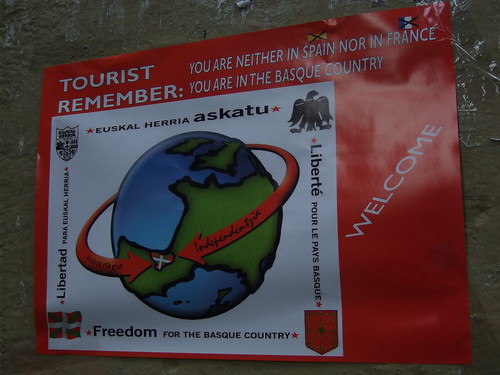
An elderly woman on a bus engaged us in conversation. I spoke in mistake-riddled Spanish. She replied that 'we have two idiomas'. 'So do we' said I. 'I know' she continued, 'and we're both at the same place'.

I was a bit puzzled and thought something had gone missing in translation. 'What place?'

'Independence', she replied.

Gora Euskadi. Saor Alba.