Pages/ duilleagan

Showing posts with label Celtic. Show all posts

Wednesday, February 12, 2014

Joe Strummer, Class War and Welsh language revival


Retro time. I recently had the good fortune to come across the welshnot site on which was a comprehensive interview with Welsh music man Rhys Mwyn.

Mwyn was one member of legendary Welsh-language punk band Anhrefn. Despite the English media not quite understanding why any band would want to use a language other than English as a medium, they enjoyed good coverage and were well respected. I saw them a few times in Edinburgh including at anti-Poll Tax fundraisers and supporting Joe Strummer and Oi Polloi on Class War's Rock Against the Rich date in Edinburgh.
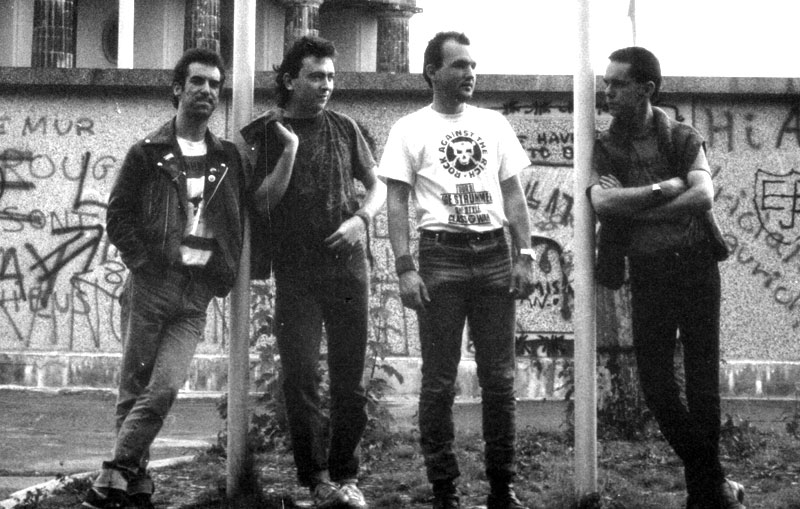
After Anhrefn, Mwyn was involved in various projects involving well-kent names such as Super Furry Animals and Catatonia. This rise in confident Welsh-language rock music was subsequently labelled 'Cool Cymru'.

Myself and Ruairidh Polloi also managed to bring Mwyn's later techno project Land of My Mothers and rockers Gwacamoli to entertain students at Sabhal Mòr Ostaig on Skye. This opened the door for other 'alternative' acts to play at the Scottish language college including ska-punks the Newtown Grunts and Breton-language rockers Sarah.

Welsh language

We always sang in Welsh but it was never done to exclude anyone. And we didn’t think of ourselves as a Welsh language band – we were just a band who sang in Welsh.
It was something we would constantly get asked about in interviews but when it came to the music itself, I’m not sure how many knew, or cared, about the language.
Anhrefn was just loud, full-on music with guitars blasting; so nobody gave a shit about the language really. As long as they liked the noise.
Our record company, Workers Playtime, did once ask us to do a song in English and we told them politely to get stuffed – they gave up trying after that. I’m sure a lack of compromise did limit our success but we were never motivated by getting on Top of the Pops or any of that.

I particularly admire Anhrefn's politics. Are they anarchists, socialists or Welsh nationalists? Who knows and who cares? They took a pragmatic approach but involved themselves in various grass roots campaigns supporting anti-Poll Tax resistance, Welsh devolution and of course, the Welsh language. This is the kind of approach that some on the anarcho/left in Scotland could learn from - voting 'yes' in the forthcoming referendum is only a new beginning. It doesn't preclude the wider aims for whatever type of fair and progressive society you wish for in the future. Voting 'no' or not voting does nothing for no-one. Mwyn's views on Welsh politics, music and Scottish independence are detailed in the link below.

Celtic Connections indeed and here's hoping we can see more of them soon.

Rhys Mwyn: Go Ahead, Punk

Thursday, January 16, 2014

Those tenuous Celtic Connections...


Sure, it brightens up a dreich Glaswegian January. Sure, it provides entertainment and employment to some. Sure, some of it is interesting. But, let's face it, a lot of it is shit. A lot of it is bland. In short, it's music to sit on your arse to.


There are always some jewels though - Shane MacGowan and the Popes, Vatersay Boys or this year's Mogwai offering. Too much of it though remains bland, uninspiring and commercial. Faded rock stars know they can add something acoustic to give their product a 'Celtic' veneer and provide a pay cheque. It's only a matter of time before Mumfart and Sons make an appearance.


Not only does Celtic Connections need to be more challenging and obnoxious but it needs to be more... Celtic.


Language is at the root of Celtic identity and unfortunately there seens to be too little of it at Glasgow's Royal Concert Hall. In the beginning, I can remember the likes of Anne Lorne Gillies giving Gaelic classes and Gaelic having some sort of profile in the official programme.

Like the morbid Royal National Mòd, Celtic Connections seems to be the nice but boring neighbour when compared to what the Bretons, Welsh or Basques do.


When organisers of the Turas Roc nan Cànan Ceilteach back in 2008 wrote to Donald Shaw - CC chief and member of supermarket-muzak band Capercaillie - they received no reply. This despite three genuine Celtic rock bands being available - Na Gathan and Oi Polloi singing in Scottish and Les Ramoneurs de Menhirs singing in their native Breton. The tour went ahead and was covered by BBC Alba on their notable Rapal programme that can still be found here.

So, here are some vids to remind the publicly funded of Celtic Connections that grassroots Celtic music that you can actually move your arse to still exists. At the very least, here's hoping they can bring the mighty Les Ramoneurs across again. Unfortunately, the late and great Yr Anhrefn from Wales are no longer with us...

Saturday, February 25, 2012

The proximity of Gaelic


Speaking to a teacher recently who had worked for a year or two in New Zealand, I found out that all primary children there learn not only some basic Maori but learn about the place of Maori in the history and culture of the country. Maori itself though is a relative newcomer to the islands - it is thought that Maori speaking people settled there around 1000 years ago. To compare to Scotland, our last indigenous people have been here for twice that or more.

Because of this, Scottish/ Gaelic is all around us in Scotland. Though if we don't speak Gaelic or learn it to some extent and aren't told about it, we don't know. The obvious step for Gaelic activists and for a Scottish government should be to make people aware of their history and environment. This should be fundamental to anyone who calls themselves an internationalist - if you don't have a nation and culture of your own, then what are you going to take to the international stage?

The Scottish Government recently announced that Scottish Studies would be mandatory at some stages of a child's education. This frightened some of the usual naysayers who see anything Scottish as being inherently inferior. To most of us, a journey into Scotland's past and present history and culture is a fascinating one. We could go back to the days when lynx and wolves were plentiful. Or examine the reasons for the building of the various monuments at Calanais or the settlement at Skara Brae. We could study the composition of Y Gododdin and the real meaning of the term 'British'. There is the Celtic knotwork and the thesis, from musicologist John Purser, that instead of being just a pretty pattern it was actually an early method of transcribing music. There are also the Picts who may have died out as a separate grouping of tribes but whose DNA lives on in many of today's Gaelic speaking population. And, of course, there's the role and place of Gaelic.


Recent evidence would suggest that the Gaels were not invaders from Ireland 1500 years ago but that they'd lived in Argyll for as long as the Picts had lived in other parts of our landmass. Sadly, Pictish is no longer with us though it is likely that some of it entered the Gaelic language.

Finally, we have a campaign to make people aware of the Gaelic that they already have on their lips in everyday Scottish language. The posters which highlight well kent words in Scotland come courtesy of Ulpan - a group that facilitates the 'ulpan' method of language teaching for the Scottish tongue. Maybe the next step is to make people aware of the Gaelic on their doorsteps? In and around Edinburgh, this could include Calton Hill as Cnoc Challtainn - Hill of the Hazel Trees or Craigentinny as Creag an t-Sionnaich or Rock of the Fox.

After all, knowledge is power and many in our society - such as racists, Unionists and religious extremists - garner their strength through ignorance and fear.

Gaelic/ Scottish then is our present and living connection to our distant past.

Further reading/ listening:
A New History of the Picts, Stuart McHardy
Scotland's Music, John Purser
Scottish Place-name Society/ Comann Ainmean-aite na h-Alba